
Vintage Bentley
Production NOS.
Where To Look For
Chassis & Engine NOS.
Bentley Specials & Special Bentleys
Unidentified
Bentleys
Articles
02 April 2013
The history of Supercharger MS3926 and more
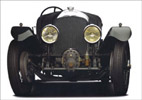
We bring you an extract from the book The Spirit of Competition, By Dr. Frederick A. Simeone outlining the history of serial no. MS3926. "I wanted to fill in some information on our blower car, MS3926. Reason I think I should do this is because, through your site, I was amazed at how few cars have original engines, transmissions, and most notably, bodies..." says Dr. Simeone, renowned neurosurgeon, automotive historian and museum owner.
 |
The history of great racing Bentleys
is well known. From 1927 to 1930, they were unbeatable
in endurance racing, having won Le Mans during those
four years with, first, a 3-liter, then a 4½-liter,
and finally, the Speed 6 in 1929 and 1930. In an effort
to get even more horsepower from the great 4-cylinder
4½-liter car, supercharging was suggested, as
already used successfully by Bugatti, Alfa Romeo and
others. There is an oft repeated story that W.O. Bentley
himself opposed this method of getting additional power.
He favored increasing engine size. The story goes that
it was Sir Henry Birkin, sponsored by the Honorable
Dorothy Paget, to whom Mr. Bentley finally relented
and made the 50 obligatory cars for sale to the public,
as well as five special racing type cars.
The supercharger operates on Rootes principles, with
two synchronized twin lobe rotors. The boost given was
10 psi at 25 miles per hour in top gear and does not
exceed 11 psi at the highest engine speeds. With this
engine and a light single-seater body, the car established
the Brooklands Outer Circuit Record at 137.9 miles per
hour. These cars were impressive in their power and
speed, but were not yare and therefore unsuccessful
racing cars. Even in local British Racing Drivers Club
competition, they usually retired in the 500 mile race
with one noteworthy second place finish in 1930. Because
a supercharged Bentley traveled the fastest on the Brooklands
banked circuit, the "Blower" will forever
be a symbol of powerful British motoring. Its pyknic
image in Rexene-clothed, cycle-fender, bells-and-whistled
armor, with the ponderous blower menacing fore is an
icon of the manly British bolide.
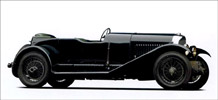 |
Serial Number: MS3926
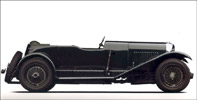
This car was ordered by T.G. Moore and it was registered
in 1931, donned in a Vanden Plas-built special aluminum
tourer body. Specified on the original build sheet are
the design features that are still on the car. The doors
were to come down to the frame rails, not the skimpy
doors so commonly seen on Vanden Plas bodies. The running
boards were to be in line with the center of the wheel
hubs. The body was to be fully valanced, which means
the front fenders extended all the way down to the chassis
and, in addition, the frame rails were louver-covered
from front fender to rear fender. The body was to be
painted Le Mans Green with the matching upholstery and
a dark walnut dashboard.
T.G. Moore, who had just acquired Motor Sport as its
publisher, must have been very proud of his new car.
It is likely that he took it to a variety of events,
but the most notable one was outlined in page 383 of
Motor Sport, April 1931. He won the timed trial of the
Isle of Man with a speed of 62.33 miles per hour, which
was significantly better than the competitors. This
proud showing was probably repeated because, ultimately,
the car was re-registered in the Isle of Man while still
under Moore's ownership. Subsequently, it went through
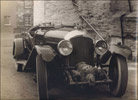
several hands and it was discovered after the war in
Aylesbury by U.S. serviceman Robert K. Carter who shipped
it to the United States. Mr. Carter had every intention
of restoring the car, but as time went on, it became
obvious that this was not happening.
 |
 |
||||
|
|||||
 |
 |
 Dr.
Frederick A. Simeone writes to Robert McLellan
Dr.
Frederick A. Simeone writes to Robert McLellanWe were looking for that nearly extinct beast, a Blower with its original body; the majority of the survivors were by then re-invented as boy racers. We bought her from Mr. Carter in 1981 and started a restoration. The car was in remarkably preserved condition though it did not have top bows, (nor does it have them now). Other than that, nothing was seriously missing. The rear end had been cut back a bit, but this was easily restored. Beyond this, all external metal was original. There were no missing instruments. The original engine and the D-type gearbox were intact and really did not require much internal fettling, although they were refreshed. The sump had to have repairs because oil had been laying in it for decades and this ate through the metal in some spots.
| Click for larger view | ||
 |
|
 |
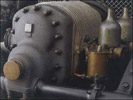
The mechanical work was done by Jim
McHenry of the Ball and Ball Shop in West Chester, Pennsylvania.
Jim and I had an excellent working relationship and
he understood exactly what had to be done. He did a
superb job on the engine and transmission. The work
on the rear of the body was easily finished and then
she was sent to Fred Hoch for paint. David George (of
D.L. George Coachworks), functioning in his usual versatile
way, managed to do a superb upholstery job exactly according
to Bentley standard. Today, she runs very well but is
no gem in the handling department. The heavy front end
resists crankling in contrast to the litheness of the
3-liter. But the sight and sound of the always exposed
blower prods the effort.
Driving Impressions: Supercharged Bentley
In the September 7, 1945 issue of The Autocar, the editor
had the pleasure of driving Woolt Barnato's 1930 supercharged
Bentley. He recalls, "I had a run in this car soon
after it was completed and it certainly had tremendous
punch, but in common with the company's own demonstration
model, it was inclined to boil in traffic and was prone
to rather a lot of spitting back from the supercharger
blow off valves. The works then fitted a compression
plate and Barnato took the car around to Brooklands
where exhaustive tests showed it to be much improved.
The speedometer went right round to 105 in top gear.
Despite the considerable weight of the car, acceleration
also proved to be pretty outstanding, 60 being obtained
from 10 miles per hour in about 15 seconds and 90 in
just about 45 seconds. The supercharger blew at a maximum
of about 10 pounds per square inch and made a very attractive
low whining sound when idling."
Four years previously, in the same magazine, a similar
blower Bentley was tested with a comment "this
example 'blower' struck me as a quite mild-mannered
machine. You could burble about with it in top gear
in an altogether surprising fashion, the engine turning
slowly on the very high ratio, about 3.3, as to make
it almost possible to count the explosion. It certainly
would tick over evenly at below the indicated 500 rpm.
As to starting, few strokes of the Ki-gass and it was
firing away."