
Vintage Bentley
Production NOS.
Where To Look For
Chassis & Engine NOS.
Bentley Specials & Special Bentleys
Unidentified
Bentleys
Articles
16 August 2013
Sir Henry Birkin and his supercharged Bentley 'Blower'
The export of the world's most expensive Bentley has been put on hold by the UK government, which has described the 1929 car as of "outstanding significance". But what do we know about the legendary "Blower" and the enigmatic aristocrat, Sir Henry Birkin, who spent his fortune developing it? Sir Henry, who was known widely by the nickname Tim, was famed as a top racing driver, always dapper in his trademark silk neckerchief flapping in the wind as he tore around Brooklands, the Nurburgring or Le Mans. Using the family fortune made through Nottingham lace, Sir Henry travelled the world, living the glamorous life of a 1920s racing hero as one of the "Bentley Boys". But he did not drive to win - he raced for the love of speed and to improve the standing of British motorsport, according to his great-great-nephew Sir John Birkin - a filmmaker who worked on a 1995 drama starring Rowan Atkinson as Sir Henry.
| The export of the world's most expensive Bentley has been put on hold by the UK government, which has described the 1929 car as of "outstanding significance". But what do we know about the legendary "Blower" and the enigmatic aristocrat, Sir Henry Birkin, who spent his fortune developing it? |
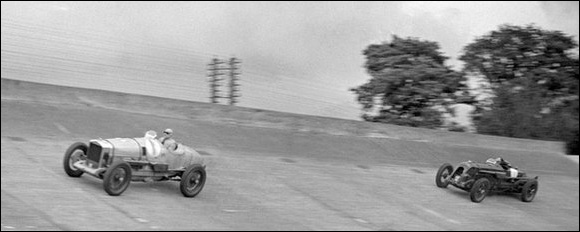 |
| Sir Henry Birkin raced at Brooklands regularly in the 1920s and early 30s |
"He was fearless and he was always
in a hurry, with the result that on many occasions he
was deprived of victory because the desire for speed
overcame his judgement and the endurance of his car,"
The Times wrote of Sir Henry.
"Dangers, the need for caution, and the advantages
of a waiting race were all sacrificed to the love of
brilliant driving at high speed."
|
||
Sir Henry, who was known widely by
the nickname Tim, was famed as a top racing driver,
always dapper in his trademark silk neckerchief flapping
in the wind as he tore around Brooklands, the Nurburgring
or Le Mans.
Using the family fortune made through Nottingham lace,
Sir Henry travelled the world, living the glamorous
life of a 1920s racing hero as one of the "Bentley
Boys".
But he did not drive to win - he raced for the love
of speed and to improve the standing of British motorsport,
according to his great-great-nephew Sir John Birkin
- a filmmaker who worked on a 1995 drama starring Rowan
Atkinson as Sir Henry.
"Sailing, shooting and cars was what he lived for
and he spent, really, all the family money on it,"
Sir John said.
"He wasn't the sort of guy who won all the races,
he was more concerned with maintaining the lap speeds
and records.
"On one occasion, at Le Mans in 1928, he managed
a lap with an average speed of 85mph. All on three wheels
because one had blown out.
"That's the kind of guy he was."
Sir Henry was an unassuming, shy man who suffered with
a stammer but his love of motors and speed began at
an early age, according to Sir John.
At the family home in Ruddington Grange, just outside
Nottingham, he was bet £15 he could not design
and build a vehicle which would make it all the way
along the drive under its own power - about three quarters
of a mile.
At every third along the route he was met by someone
holding a £5 note - he used the money to buy his
first proper car.
Severed head
When Sir John went back to the family house, long since
demolished, he found a stable with the words "every
day, in every way, faster and faster" daubed on
a wall by Sir Henry.
And a favourite family tale involves Sir Henry driving
a Bentley up the staircase of the Savoy Hotel during
a glitzy dinner.
Despite the roaring 20s and living the life of a motoring
hero, it was not all smiles - his wife left him, taking
the children, after becoming tired of playing second
fiddle to his driving.
And Sir John believes his relative would never have
got into motorsport had it not been for the tragedies
of World War I.
| Click for larger view | ||
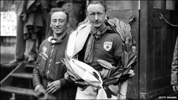 Sir Henry "Tim" Birkin, who was always seen wearing his spotted silk neckerchief, was renowned for his speed and won the 1931 Irish Grand Prix at an average speed of 88.8mph |
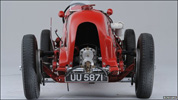 His supercharged Bentley "Blower" was recently bought at auction for more than £5m by a foreign bidder |
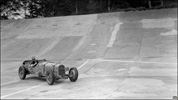 Sir Henry, seen here in an Alfa Romeo, set the record at Brooklands travelling at 137mph in his Bentley on a deeply rutted and bouncy course |
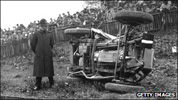 |
| Crashes at Brooklands racecourse were frequent and often fatal |
Sir Henry was commissioned into the
Royal Warwickshire Regiment and then the Royal Flying
Corps, the precursor to the RAF.
Like other men of his generation, his experience of
war left him with a zest for life and no fear.
Racing drivers in the 1920s had a short life expectancy.
According to his family, he was once racing at Brooklands
when he saw an object bounce across the track.
He said to himself 'what could that be?' before realising
it was a competitor's head - it had been severed in
an accident.
Despite his own success on the racecourse and holding
the record lap time at Brooklands in Surrey - regarded
by some as the birthplace of British motorsport - Sir
Henry felt British sports car-makers were falling behind
their Europe competitors.
'Every schoolboy's hero'
It was this belief that drove him to try to persuade
WO Bentley, then head of the luxury car company, to
develop the supercharged Blower.
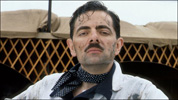 |
| Rowan Atkinson as Sir Henry Birkin racing round Brooklands |
But the Bentley boss was not interested,
and so Sir Henry chose to sink much of his own money,
and that of several supporters, into developing the
four-and-a-half litre supercharged Bentley.
It was a huge success on the track and he finished second
at the French Grand Prix at Pau in the vehicle.
According to Bonhams, which sold Sir Henry's Bentley
Blower at Goodwood Festival of Speed last year, a recent
test drive revealed it was still "on song".
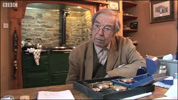
It was owned by the celebrated watchmaker and vintage
car collector Dr George Daniels, and fetched £5,149,800
- sold to an anonymous bidder from outside the UK.
The car, and the man behind the wheel, were once the
talk of a nation - it was the vehicle James Bond drove
in the first novel Casino Royale.
"He was a big hero at the time, someone every schoolboy
will have known about," Sir John said.
"I still meet men in their 80s who knew of him
- they speak of him in awe and say they followed his
story.
"He had the right image, was very English and very
self-effacing.
"We just wish he hadn't spent all the money!"
 |
| Crashes at Brooklands racecourse were frequent and often fatal |
Sir Henry's racing days, and spending,
came to an end after an accident driving in the Grand
Prix de Tripoli in a race which he ultimately finished
third.
He suffered a serious burn to his arm that became infected
and developed into septicaemia, a blood infection, which
led to his death in June 1933, penniless and in a London
nursing home.
He is buried in Blakeney, Norfolk.
That period can be extended to May 2014 if there is a realistic chance of the money being found.