
Vintage Bentley
Production NOS.
Where To Look For
Chassis & Engine NOS.
Bentley Specials & Special Bentleys
Unidentified
Bentleys
Articles
11 June 2010
Bentley 3 & 4½ Litre - W.O's winged wonders
Despite the legends that surround the original Bentley cars—those sometimes called “W.O.s” after the company founder—a great portion of those near 90-year-old cars are in fine running order today. Enthusiast motoring is these cars’ raison d’être, and the faithful who maintain them take pride in upholding the founder’s ideal.
There is something hugely imposing about a vintage Bentley automobile aside from its massive scale; perhaps it’s a combination of the famous ghosts each car carries, the spirits of wealthy playboy racers, forward-thinking engineers and the man who was determined to build England’s finest sporting cars. Despite the legends that surround the original Bentley cars—those sometimes called “W.O.s” after the company founder—a great portion of those near 90-year-old cars are in fine running order today. Enthusiast motoring is these cars’ raison d’être, and the faithful who maintain them take pride in upholding the founder’s ideal. If you’ve ever harbored dreams of thundering down the Mulsanne Straight at Le Mans behind the winged “B,” you may be the right sort for vintage Bentley ownership.
 |
It may be hard to imagine, considering
that most of the models built in the last half century
have been ultra-luxury sedans, but the first Bentleys
were based on race cars. Patterned after the Humber
racers built for the Isle of Man Tourist Trophy, and
using advanced engine design technology and the future
industry-standard light aluminum pistons that W.O. developed
during World War I for aircraft engine use, the first
series of Bentley cars were called 3 Litres, for the
displacement of their four-cylinder engines.
The 3 Litre entered production in the spring of 1921,
and like many high-end cars of the period, it was available
in different chassis lengths. The standard 9-foot, 9
1/2-inch chassis was intended for lighter, more sporting
coachwork, and a long standard 10-foot, 10-inch chassis,
new for 1923, was intended to support formal coachwork;
cars so adorned often wore a blue “label,”
or a blue-colored background for the radiator shell’s
cloisonné badge. A high-performance short chassis
variant built from 1924 to 1929 was designated “Speed,”
and it was embellished with a red label badge.
 |
||||||
| The 3
and 4.5-liter four-cylinder engines are virtually
bulletproof; their only durability issues are the possibility of broken cross-shaft gears and failed center main bearings, after many miles of hard use. |
||||||
|
||||||
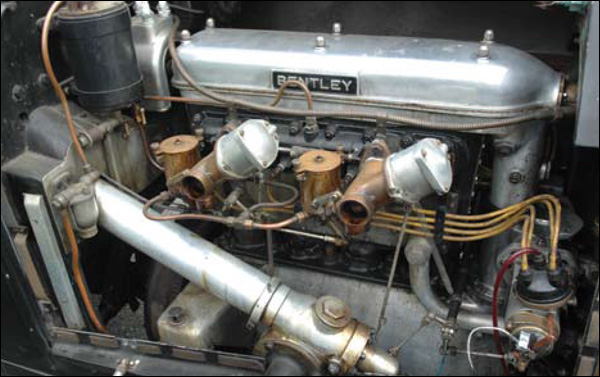
The 3 Litre’s engine used a five main bearing crankshaft and was cast en bloc, so there was no possibility of head gasket failure. It displaced 2,996cc via its 80mm bore and 149mm stroke, and followed Grand Prix engine practice by incorporating a single overhead camshaft to geardrive four valves per cylinder. Twin ML magnetos modulated two spark plugs per cylinder, and the standard fuel delivery system was a five-jet Smith-Bentley carburetor, while Speed models were fitted with twin “sloper” SU carburetors. The standard 4.3:1 compression ratio allowed for 70hp at 3,500 RPM, while Speed models’ 5.3:1 ratio gave them 85hp. The only transmission available was a four-speed manual, and rear axle ratios from 3.78 to 4.23 could be specified.
|
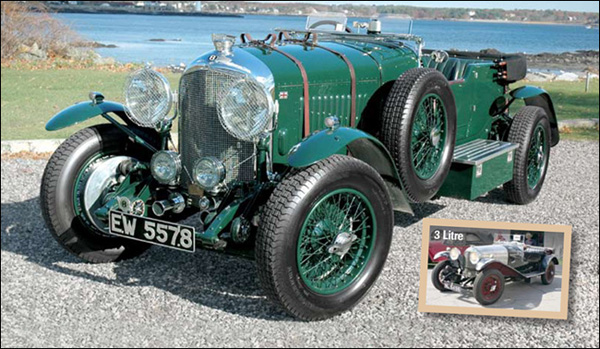
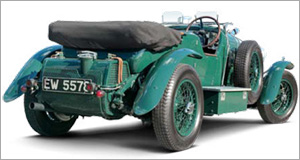
Because every Bentley left the Crickle-wood factory in North London as a rolling chassis, owners had their choice of coachbuilders to craft the car bodies. A number of prominent firms had their hand at bodying Bentleys in all forms of ‘saloon’ (sedan) and ‘tourer’ (open car); among them were famous names like J. Gurney Nutting, Hooper, H J Mulliner, Thrupp & Maberly and Freestone & Webb. It was the artisans at Vanden Plas who constructed, among other body styles, the famous Weymann-type fabric-covered open touring bodies that were used on Bentley’s Le Mans racing cars. Other coachbuilders worked in this style, too: the H.M. Bentley and Partners (W.O.’s brother) firm actually rebodied our photo car in 1935, as it had been born in 1928 as a George Maddox & Sons of Huntingdon four-door saloon.
Although they happily sold their standard
cars to wealthy clientele to engage in more sedate motoring,
it was in competition that W.O. Bentley knew his car’s
value would be proven. The second Bentley car ever built
drove to victory in the Whitsun Junior Sprint Handicap
in 1921, and in 1922, the first three cars, now prepared
as a team, took on Britain’s grueling Isle of Man
Tourist Trophy race and finished, a rarity even for
established automakers. Winning a team prize inspired
Bentley to build 71 “TT Replica” models—short
standard wheelbase cars with raised compression and
a Claudel-Hobson carburetor, costing £1,295—in
1922 and 1923.
In an unusual move, W.O. had a special boattail racer
built to run in that year’s Indianapolis 500, although
it finished in 13th place; not letting this seeming
flop dissuade him, he took the special highoutput, 9-foot
‘short’ chassis version of the 3 Litre to
France to run against Bugattis, Mercedes-Benzes and
the like at Le Mans, where his cars won outright in
1924 and 1927, inspiring numerous Le Mans replicas and
the 18 “100 MPH” models, also known as the
“Supersports” green label cars built between
1925 and 1927, the latter being the last year that the
3 Litre was produced.
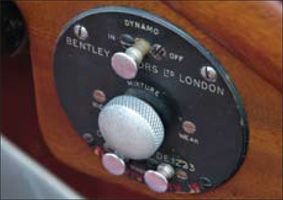
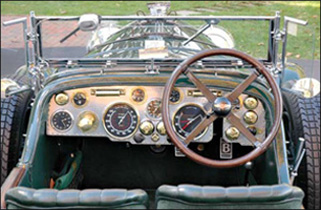 Most 1921-1931 Bentleys use a fascia of aluminum or varnished wood, depending on the style of the coachbuilder; the gauges fitted give the cars a vintage aircraft feel, and all can be rebuilt if needed. |
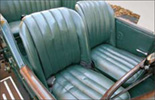 
Fine leather covers every soft surface, and skilled upholsterers can recreate an interior with ease. |
Six-cylinder Bentley cars, in the form
of the 147hp 61/2 Litre and 180hp Speed Six, were introduced
in 1926, and these cars would win Le Mans again in 1929
and 1930. The four-cylinder 3 Litre was revised into
the 4 1/2 Litre, the car that would spawn what is arguably
the most famous of all W.O. cars, despite it being one
that he himself didn’t approve of: the 50 supercharged,
175hp “Blower Bentleys” built in 1929 at the
request of one of his prominent patrons for racing homologation
purposes.
Being a development of the 3 Litre models, the black
label badged 1927-1931 4 1/2 Litre Bentley was also
available in long standard (10 feet, 10 inches) and
short standard (9 feet, 9 1/2 inches) chassis lengths,
although just 10 short chassis were built. Its twin
SU-fed 4,398cc fourcylinder engine used a 100 x 140mm
bore and stroke and a 5.1 to 5.3:1 compression ratio
to make 100hp at 3,500 RPM. This change raised the car’s
average maximum speed from 80 to more than 90 MPH; light,
open cars like the famous cyclefendered, Vanden Plas-bodied
Le Mans replicas could now better 100 MPH off of the
showroom floor, a boon in the competition in which these
cars were often engaged. Some late 4 1/2 Litre cars
were fitted with the heavy-duty crankshaft of the supercharged
model, improving their legendary durability yet further.
Sadly, Bentley Motors Ltd. was nearing the end of its
days as an independent company; Rolls-Royce purchased
the firm in 1931.
The issue of placing a standardized value on a vintage
four-cylinder Bentley can be a thorny one, explains
Robert McLellan, Bentley historian and the host of the
www.vintagebentleys.org website. “The most fundamental
aspect is learning about the cars before buying one,”
he explains. “The biggest problem is that most
buyers think they are getting an original car when they
are not; they then realize they paid too much. Our website
tells the history, so buyers and sellers will actually
know what they are looking at. Most ‘experts’
cannot tell the cars apart—two cars can look identical,
and one is only worth half of what the other is worth.”
David Brownell, former editor of Hemmings Motor News
and Special Interest Autos magazine, Automobilia Auctions
founder and the 25-year owner of a 1924 Bentley 3 Litre
touring car, adds, “In terms of values, the car
that’s never been mucked with is worth more than
a comparable car that is running its second body, but
the fact that a body’s been changed doesn’t
eliminate it from Bentley Club activities. Some people
will try to bring a chassis or car back to its exact
correct original configuration, but the penalty of doing
that with a closed car—a sedan or limousine—
is that the market demand and value aren’t there
for all of that work, and it usually costs more money
to build a closed car body than it does to build a roadster
or phaeton.
“Gooding just sold a 1927 long-wheelbase 3 Litre
tourer at Pebble Beach; this was a matching numbers
car with a one-off body by Harrington, and it was very
well restored and presented. That car, with the buyer’s
premium, brought $308,000. The sellers of a 1924 3 Litre
Speed that was featured at the Bonhams Brookline [Massachusetts]
auction turned down a bid of $230,000, and that car
needed a lot of loving; I think if that car had cracked
$250,000, they probably would have let it go. That’s
a strong price to pay for a car that essentially was
all right, but cosmetically was in need.”
David continues, “They’re great fun, a good
value. Dare I say, [vintage Bentleys] are a good investment,
because there’s an international demand for them.
People want them here, they want them in England and
in Europe. These cars work on a number of levels in
terms of use: They’re Full Classics, they’re
a vintage sports car that you can race, they’re
eligible for AACA activities, they can go to concours,
they have a lot going for them in terms of acceptability.
They have quite a heritage, and that’s part of
what you’re buying when you buy a Bentley. It’s
that great racing heritage, the great engineering, the
toughness. Everything’s very overbuilt—there’s
nothing delicate about a vintage Bentley,” he says.
“I couldn’t afford to buy mine today—they’re
not cheap. They’re going to cost you a lot of money.”
Body/Frame
A huge variety of coachwork was fitted to the three
chassis lengths that 3 and 4 1/2 Litre cars were built
on, and the frames themselves were overbuilt with truss
braces and five crossmembers; an even sturdier frame
was employed under the 4 1/2 Litres built after the
spring of 1929. Original frames are available from specialist
sources today for those who want to body a vintage Bentley
in their chosen style and trim.
As we’ve noted, many 3 and 4 1/2 Litres look different
today than they did new, but this is not necessarily
detrimental, as sporting open bodies are more highly
sought than formal closed ones. Because they were coachbuilt
cars with bodies and fenders crafted in aluminum or
aluminum, wood and fabric, skilled restorers can bring
even the worst basket cases back to life, given suitable
time and money.
Engines
The 2,996 and 4,398cc 16-valve four-cylinder engines
have been lauded for decades for their durability, but
cars that have been driven with vigor may experience
broken cross-shaft gears. “These are the gears
that go across the tower that goes up to the camshaft,
and their teeth engage the gears that run the magnetos.
The reason they break is not because they’re weak
or badly designed, but because on start-up, they’re
the last part of the engine to get lubrication,”
David explains. “The man who previously owned my
car was a professional restorer, and this happened to
him on a tour in California. He stopped into a place
that did machine work for the aircraft industry, and
had new gears made out of Delrin, a space-age plastic.
This Delrin doesn’t need lubrication, so my cross-shaft
gear worries are over.” Another engine mod that
helps longterm durability is the addition of a modern
oil filtration system to improve upon the primitive
original.
“If you have a really worn engine, the center main
bearing is liable to let go, as that’s the one
that takes a lot of crankshaft whip from the unbalanced
crankshaft. This happened to my car when it had already
done about 200,000 miles, and at that time, we measured
the taper in the cylinders: It was zero. We didn’t
have to replace the pistons or rings, and that’s
a hell of a tribute to the metallurgy in that car. They’re
very, very hard to hurt.” Because the head and
block are cast as one, the engine must be removed to
do this work.
There are a number of vintage Bentley specialists in
the United Kingdom and the U.S., so any engine part
that may be required can either be sourced new or refurbished.
Transmission/Diff erential
W.O. Bentley specified a number of different transmissions
in his four-cylinder cars for the different bodies and
uses that they would encounter, and they differed in
gearing. All were four-speed manuals, and among the
variants were the closeratio A and D type units, the
wide ratio B type and the wide/close ratio C type unit.
An inverted cone clutch with Ferodo lining was used
until a plate clutch replaced it in 1929, and like the
gearbox, this often requires a bit of effort to engage.
Because many vintage Bentleys remain in serious use
today, the swapping of interchangeable gearboxes to
achieve better performance is considered quite acceptable,
as is the adoption of a modified Laycock overdrive unit,
a similar type as used in Austin-Healey sports cars.
The semi-floating rear axle with spiral bevel gears
is another notably sturdy component, and substituting
different gearing can improve the performance of a car
with little hassle.
Suspension/Brakes
Three Litre models built through the fall of 1923 had
mechanical drum brakes on the rear wheels only, but
after that, front drums were added, and the handbrake
acts on separate shoes on the rear wheels. “For
their time, they have excellent brakes,” David
says. “That doesn’t mean that they’ll
stop like Brembo discs today, but in the context of
their time, they have really good brakes.”
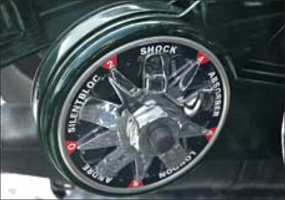
All 3 and 4 1/2 Litre cars use semi-elliptic leaf springs,
those in the rear underslung, as well as adjustable
duplex Hartford shock absorbers at all four wheels,
offering a firm ride with little body lean. Rudge Whitworth
wire wheels in 21- inch diameters were standard on early
cars, and later ones used 19-inch wheels. As would be
expected, steering effort is high, although it is laudably
accurate.
The addition of a power steering kit—seemingly
inconceivable in such an old car—is also an accepted
modification, as David explains; “This kit fits
in so neatly that you literally don’t know it’s
there.”
Interior/Trim
If your 1921-1931 Bentley is missing its dashboard clock
or fender lamps, you won’t be able to ring up your
local auto parts store to find replacements. It is therefore
lucky that vintage Bentley specialists and enthusiasts
within the Bentley Owners Club are a tight-knit bunch
who are willing to help each other with spares, and
if necessary, patterns to remanufacture needed part.
Specialists
Dennison-Jayne Motors
610-436-8668
www.dennisonjaynemotors.com
Tim Houlding International Vintage
Bentley Cars
011 44 1905 352 419
www.vintagebentley.co.uk/index.htm
Stanley Mann Racing
011 44 1923 852 505
www.stanleymann.com
The Vintage Garage
802-253-9256
http://vintagegaragevt.com
Vintage Bentley Parts Ltd.
011 44 1926 496 739
www.vintagebentleyparts.co.uk
Parts Prices
Brake shoe, front or rear - £300 ($483)
Bulkhead, 4½ Litre, original - £580 ($935)
Complete 9-foot 9½-inch chassis, 3 Litre - £6,936
($11,176)
Engine block, 3 Litre original - £1,000 ($1,611)
Engine, 3 Litre original - £12,500 ($20,141)
Gas tank, 4½ Litre restored - £700 ($1,128)
Grease gun, Tecalemit original - £75 ($121)
King pin - £155 ($250)
Mirror, original - £225 ($363)
Pedal shaft, cone clutch - £1,656 ($2,668)
Wrench set, original - £100 ($161)
Club Scene
The Bentley Drivers Club Ltd.
W.O. Bentley Memorial Building
Ironstone Lane
Wroxton, Banbury, Oxfordshire
OX15 6ED England
011 44 1295 738 886
www.bdcl.org
Dues: £50.00 ($81); Membership: 3,600
www.vintagebentleys.org
Historical Bentley restoration information and references,
links and profiles
Values - Bentley
3 and 41/2 Litre*
Low
Average
High
3 Litre $185,000
$250,000 $600,000
41/2 Litre $300,000
$450,000 $800,000
*Values vary widely and depend upon condition, body
style, originality, provenance etc.
Bentley Production*
3 Litre
Long standard wheelbase: 765
Short standard wheelbase: 194
Speed model: 513
Tourist Trophy and Tourist Trophy replica: 71
Light Tourer: 40
Supersports/100 MPH: 18
Indianapolis 500 racer: 1
Unknown: 11
Total 3 Liter production: 1,613
4 1/2 Litre
Long standard wheelbase: 657
Short standard wheelbase: 10
Total 4 1/2 Litre production: 667
*Production figures courtesy Bentley-Fifty Years
of the Marque, Third Edition, by Johnnie Green.